

Most EU exports to Brazil wait until 2036 for zero duty, then save US$4.2bn a year
We matched every product Brazil buys from the EU to its tariff schedule under the EU–Mercosur agreement. The saving is large, slow and concentrated, and one legal question still moves it.
Contents
Key takeaways
The EU–Mercosur agreement is a schedule, not a switch. What it is worth depends on the product, the year and one open legal question.
-
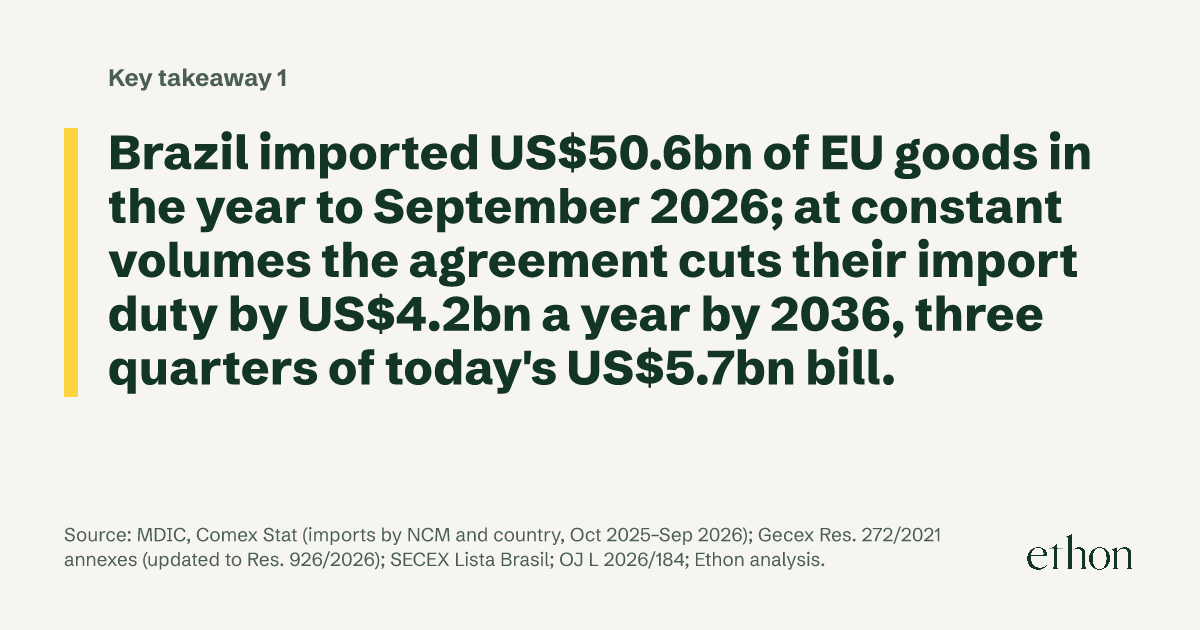
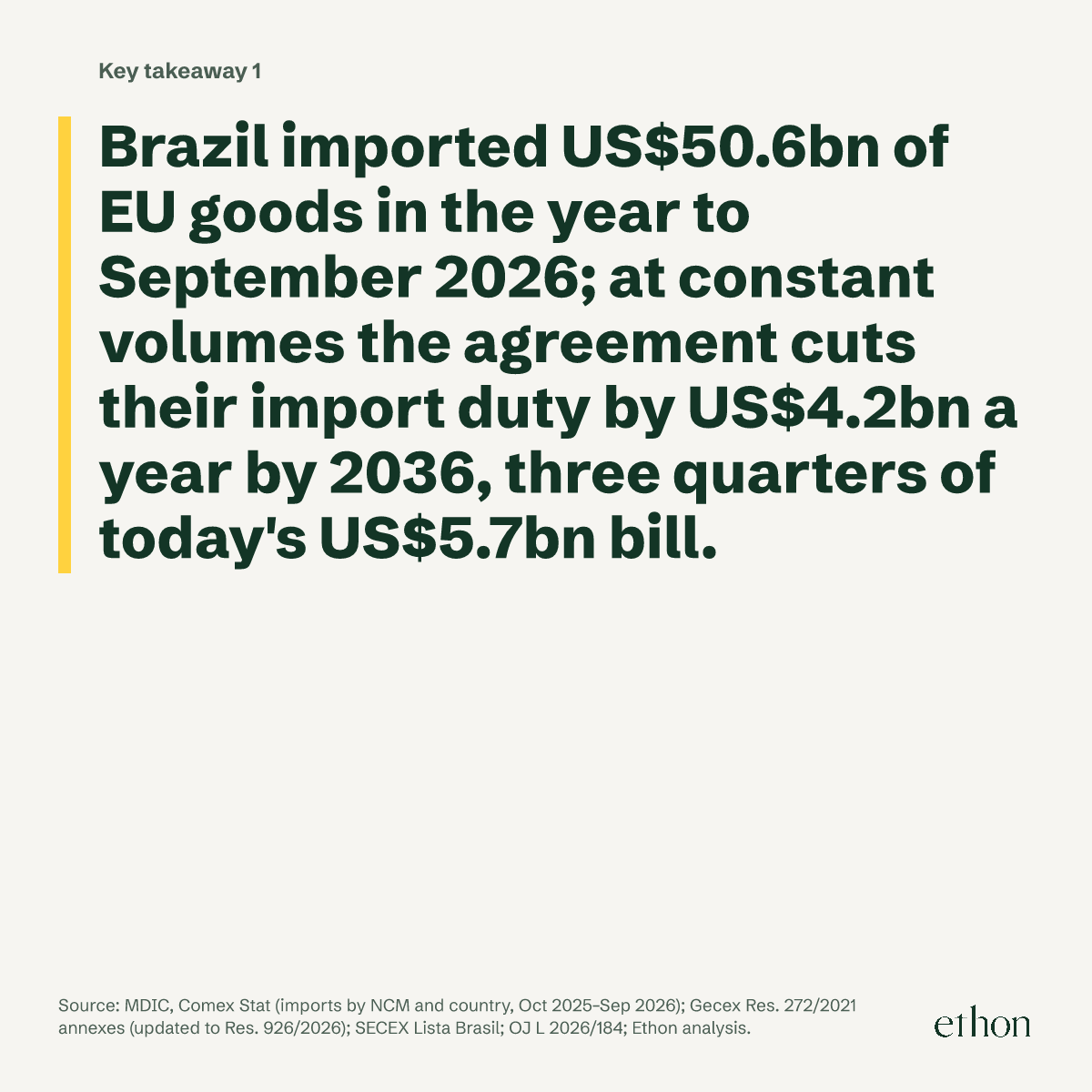
Brazil imported US$50.6bn of EU goods in the year to September 2026; at constant volumes the agreement cuts their import duty by US$4.2bn a year by 2036, three quarters of today's US$5.7bn bill. See Exhibit 1
-
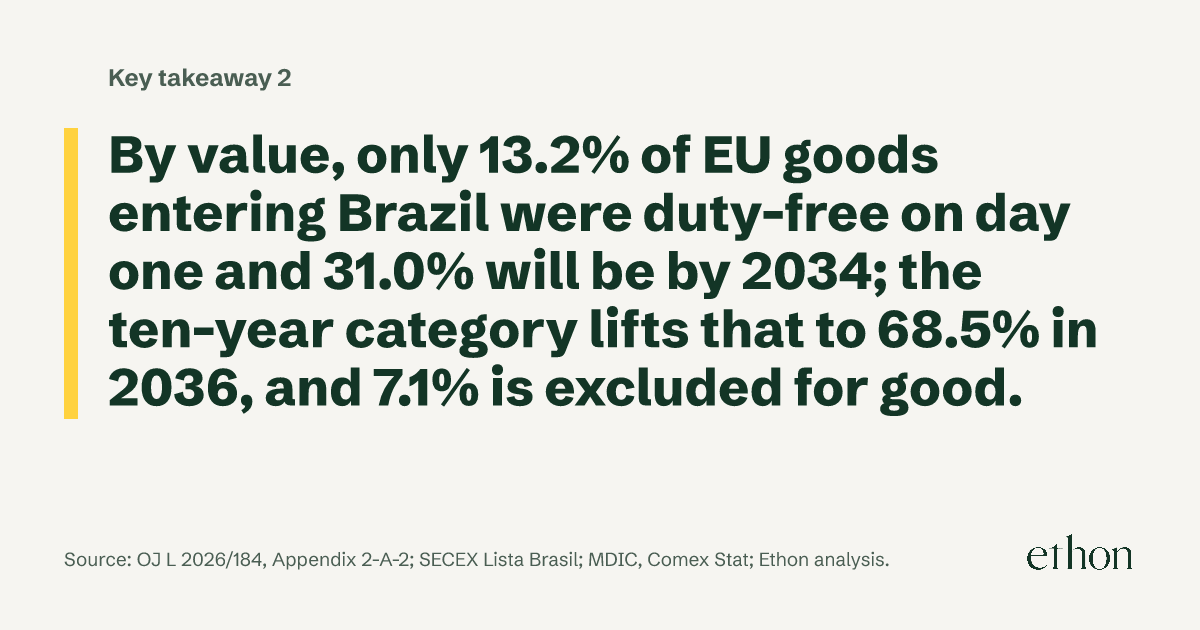
By value, only 13.2% of EU goods entering Brazil were duty-free on day one and 31.0% will be by 2034; the ten-year category lifts that to 68.5% in 2036, and 7.1% is excluded for good. See Exhibit 2
-
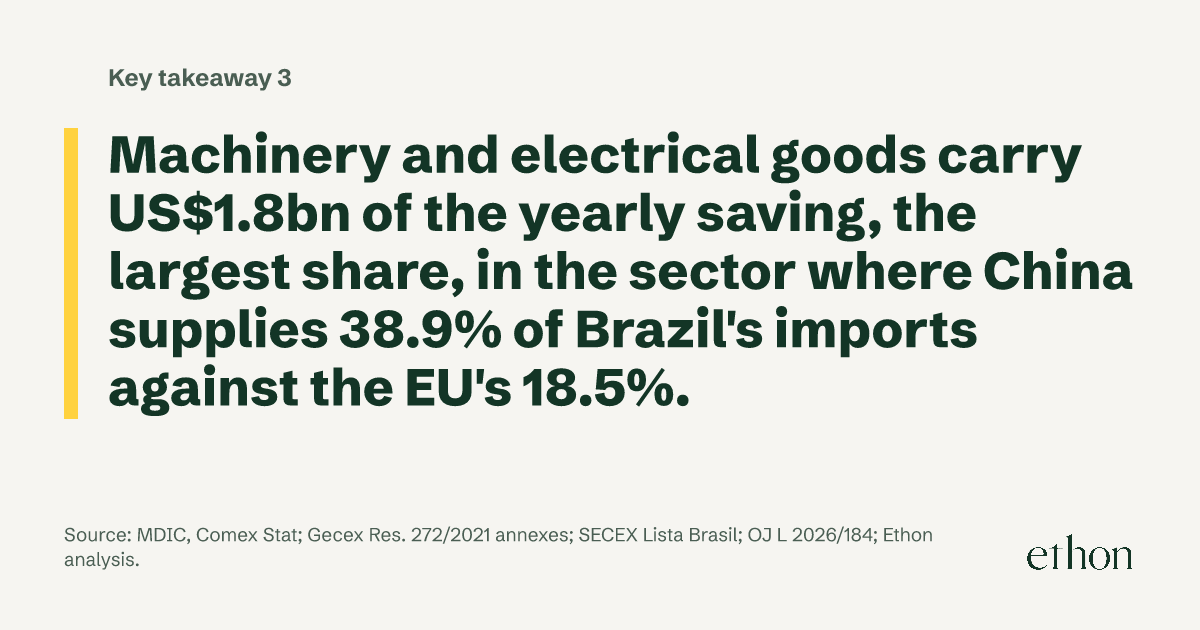
Machinery and electrical goods carry US$1.8bn of the yearly saving, the largest share, in the sector where China supplies 38.9% of Brazil's imports against the EU's 18.5%. See Exhibit 4
-
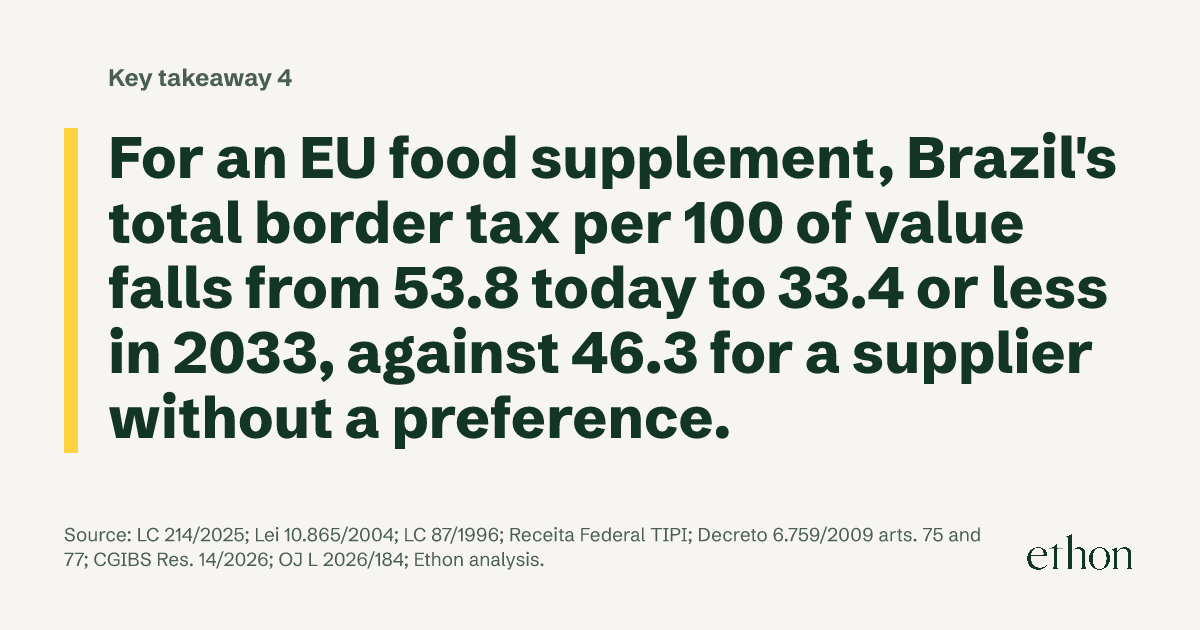
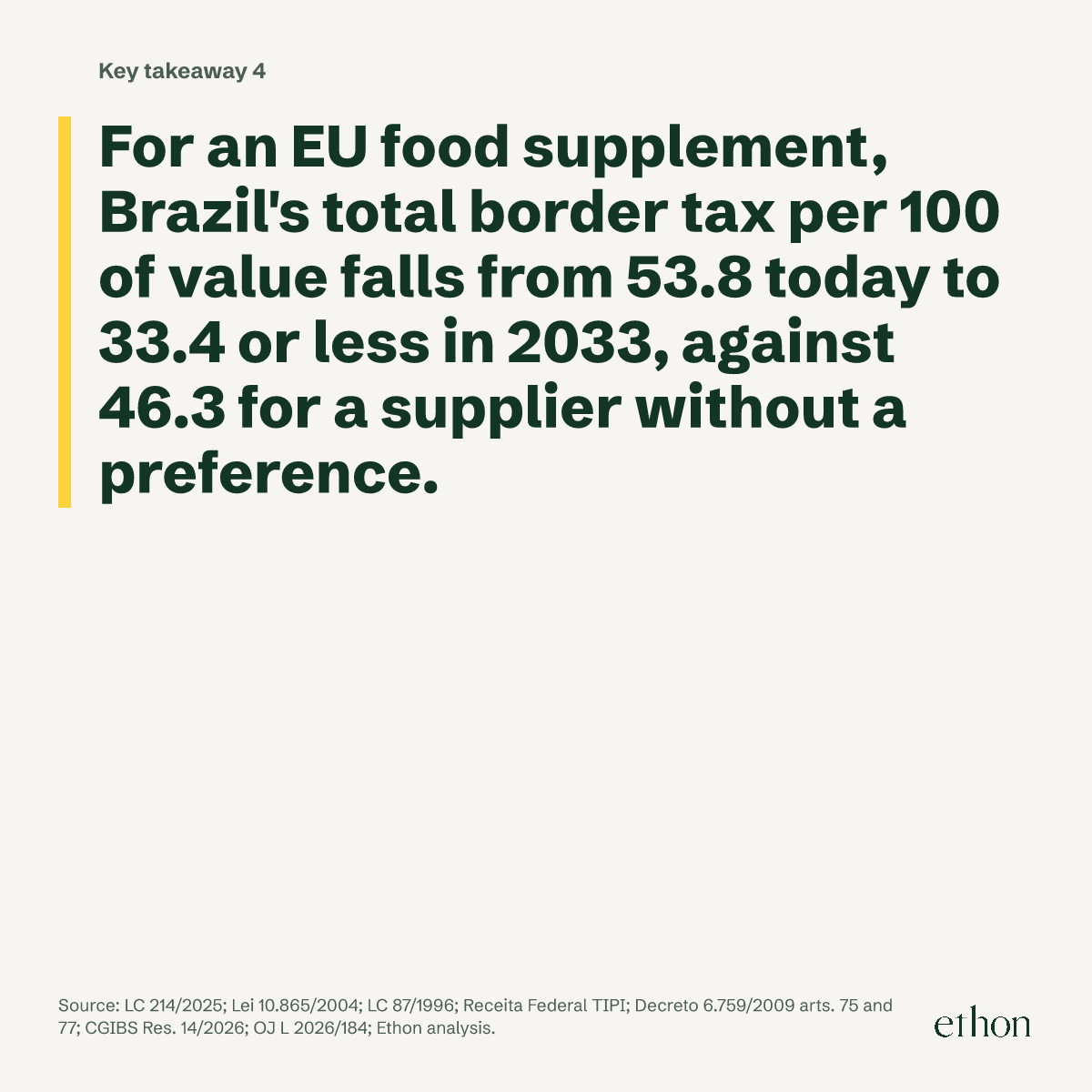
For an EU food supplement, Brazil's total border tax per 100 of value falls from 53.8 today to 33.4 or less in 2033, against 46.3 for a supplier without a preference. See Exhibit 6
The EU–Mercosur Interim Trade Agreement has applied provisionally since 1 May 2026. In the twelve months to September 2026 Brazil imported US$50.6bn of goods from the EU, 17.4% of everything it bought abroad, and at today’s applied rates those goods carry about US$5.7bn of import duty a year. The agreement removes most of that bill, but slowly, and very unevenly across sectors.
We matched every eight-digit product Brazil imported from the EU to its staging category in the agreement and to Brazil’s applied rate, using Brazil’s own trade statistics and tariff tables. Then we traced one product, food supplements, through Brazil’s full tax stack. Held at today’s volumes, the yearly duty saving for EU goods grows from about US$0.8bn–0.9bn in 2026 to US$4.2bn in 2036. (See Exhibit 1.)
Exhibit 1
At today's volumes, the agreement cuts EU goods' yearly import duty in Brazil by US$4.2bn by 2036
Yearly import duty avoided by EU-origin goods entering Brazil versus Brazil's applied rates, at October 2025–September 2026 volumes, under two readings of Art. 2.4(7) (US$bn)
Column chart of yearly import duty avoided by EU goods entering Brazil at today's volumes. Reading one: US$0.92bn in 2026, 1.25 in 2027, 2.26 in 2030, 3.26 in 2033, 4.22 in 2036 (highlighted) and 4.59 in 2041. Reading two: 0.78, 1.10, 2.13, 3.18, 4.21 and 4.59.
Note: Statutory duty at applied rates on EU imports of US$52.1bn (CIF); today's bill is US$5.66bn. Constant volumes, prices and applied rates. 2026 shown at the year-0 rate for a full year. No saving counted for the 9.8% of value under quotas, special tables or split sub-lines. Ex-tarifário reductions, drawback and special regimes are not modelled, so actual duty paid today, and the saving, are lower.
Source: MDIC, Comex Stat (imports by NCM and country, Oct 2025–Sep 2026); Gecex Res. 272/2021 annexes (updated to Res. 926/2026); SECEX Lista Brasil; OJ L 2026/184; Ethon analysis.
View data
| Cut from the lower of base and applied rate | Cut from the base rate | |
|---|---|---|
| 2026 | US$0.92bn | US$0.78bn |
| 2027 | US$1.25bn | US$1.10bn |
| 2030 | US$2.26bn | US$2.13bn |
| 2033 | US$3.26bn | US$3.18bn |
| 2036 | US$4.22bn | US$4.21bn |
| 2041 | US$4.59bn | US$4.59bn |
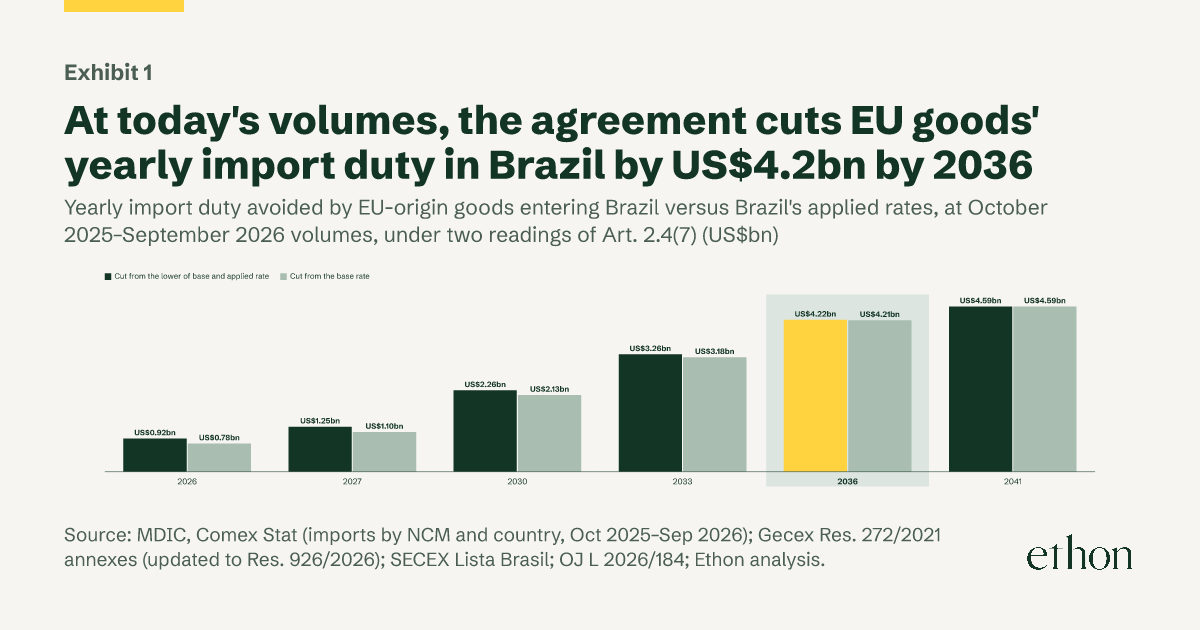
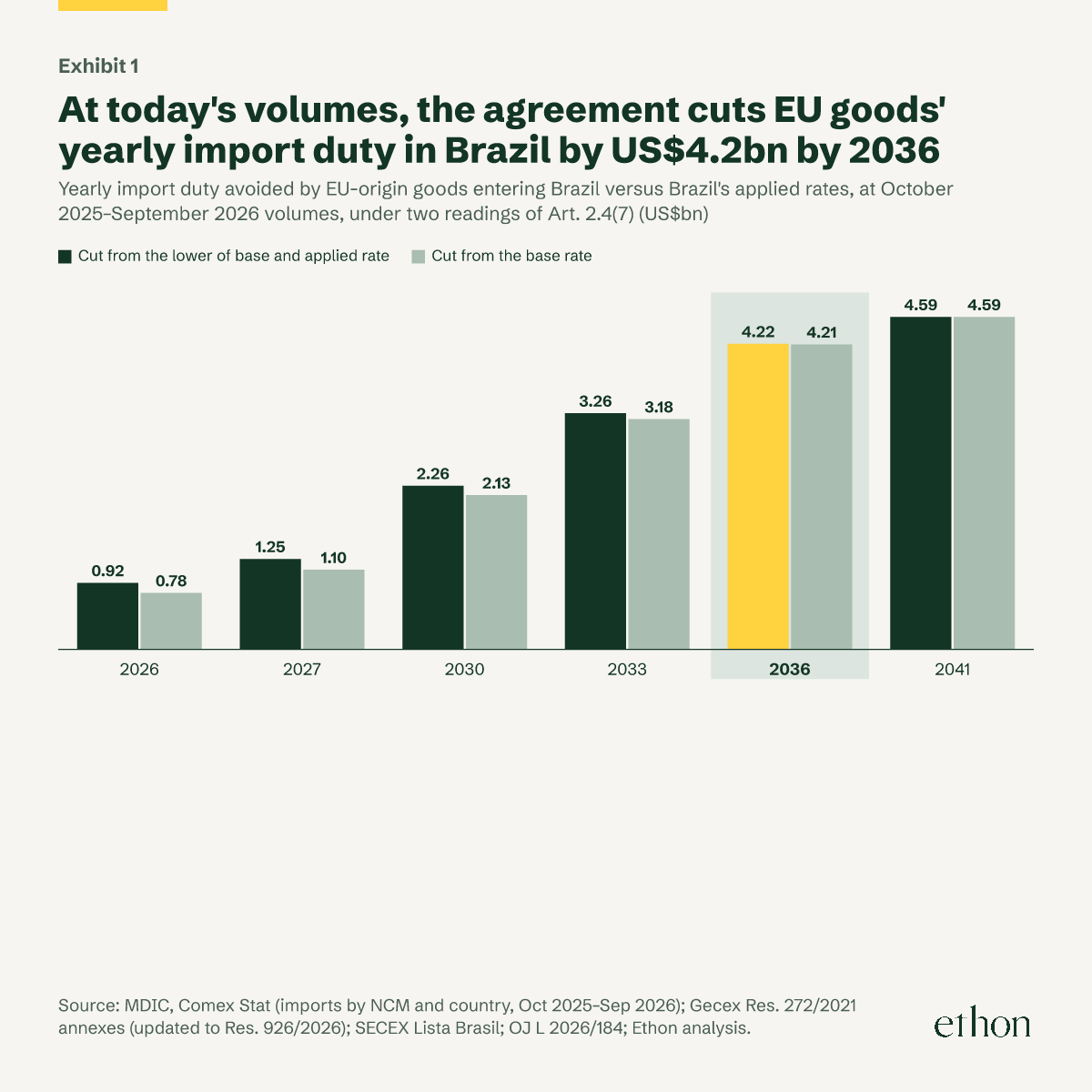
The saving builds year by year because most lines lose a fixed slice of their duty every 1 January. It is still rising in 2041, when the fifteen-year category lands, and it never reaches the full bill: excluded lines, quotas and special regimes keep about a fifth of today’s duty in place.
By value, EU trade reaches zero duty more slowly than the tariff-line count suggests
Brazil’s commitments sit in Appendix 2-A-2 of the agreement: 10,030 tariff lines, each with a Brazilian base rate and a staging category. Category 0 lines became duty-free on 1 May 2026. Categories 4, 8, 10 and 15 fall in equal annual steps and reach zero on 1 January 2030, 2034, 2036 and 2041. Category E lines are excluded and stay at the base rate.
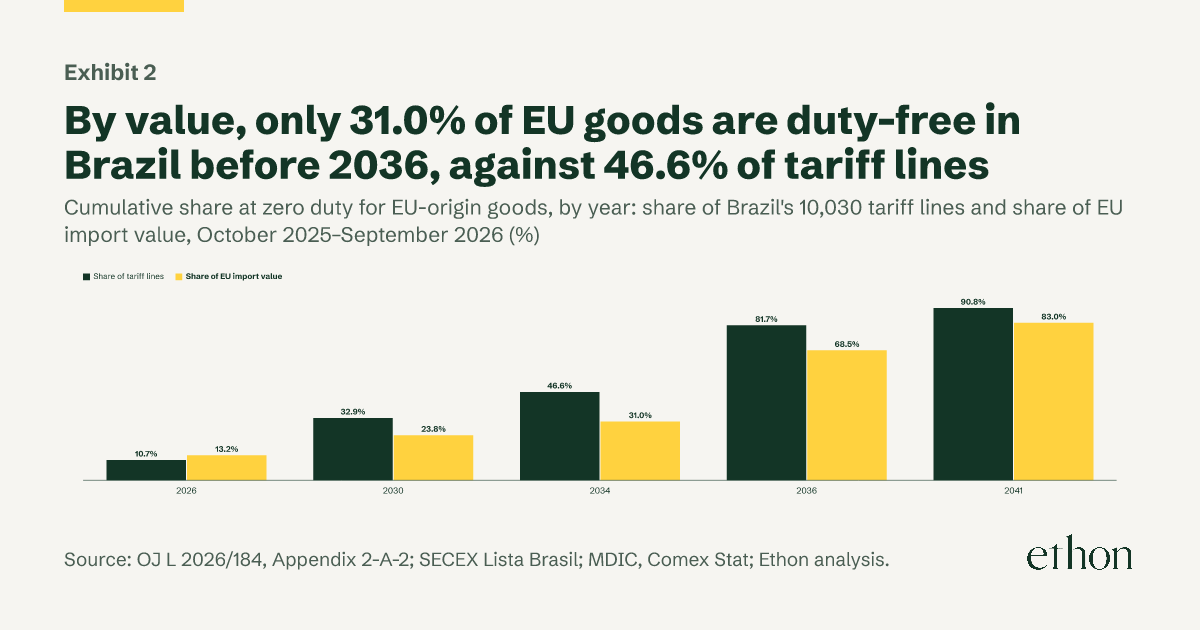
Counted by lines, the schedule looks front-loaded: 46.6% of lines are at zero by 2034. Weighted by what the EU actually sells Brazil, it is not. Only 31.0% of EU import value is duty-free by 2034, because the categories that hold the most trade are the slow ones. (See Exhibit 2.)
Exhibit 2
By value, only 31.0% of EU goods are duty-free in Brazil before 2036, against 46.6% of tariff lines
Cumulative share at zero duty for EU-origin goods, by year: share of Brazil's 10,030 tariff lines and share of EU import value, October 2025–September 2026 (%)
Column chart comparing the share of Brazil's tariff lines and the share of EU import value at zero duty. Lines: 10.7% in 2026, 32.9% in 2030, 46.6% in 2034, 81.7% in 2036, 90.8% in 2041. Value (highlighted): 13.2%, 23.8%, 31.0%, 68.5% and 83.0%.
Note: Position on 1 January of each year, except 2026 (1 May). Lines: agreement schedule (NCM 2012). Value: EU imports of US$50.6bn FOB by current NCM, mapped to categories with SECEX's Lista Brasil. Lines and value under quotas, special tables or split sub-lines are not counted as reaching zero.
Source: OJ L 2026/184, Appendix 2-A-2; SECEX Lista Brasil; MDIC, Comex Stat; Ethon analysis.
View data
| Share of tariff lines | Share of EU import value | |
|---|---|---|
| 2026 | 10.7% | 13.2% |
| 2030 | 32.9% | 23.8% |
| 2034 | 46.6% | 31.0% |
| 2036 | 81.7% | 68.5% |
| 2041 | 90.8% | 83.0% |
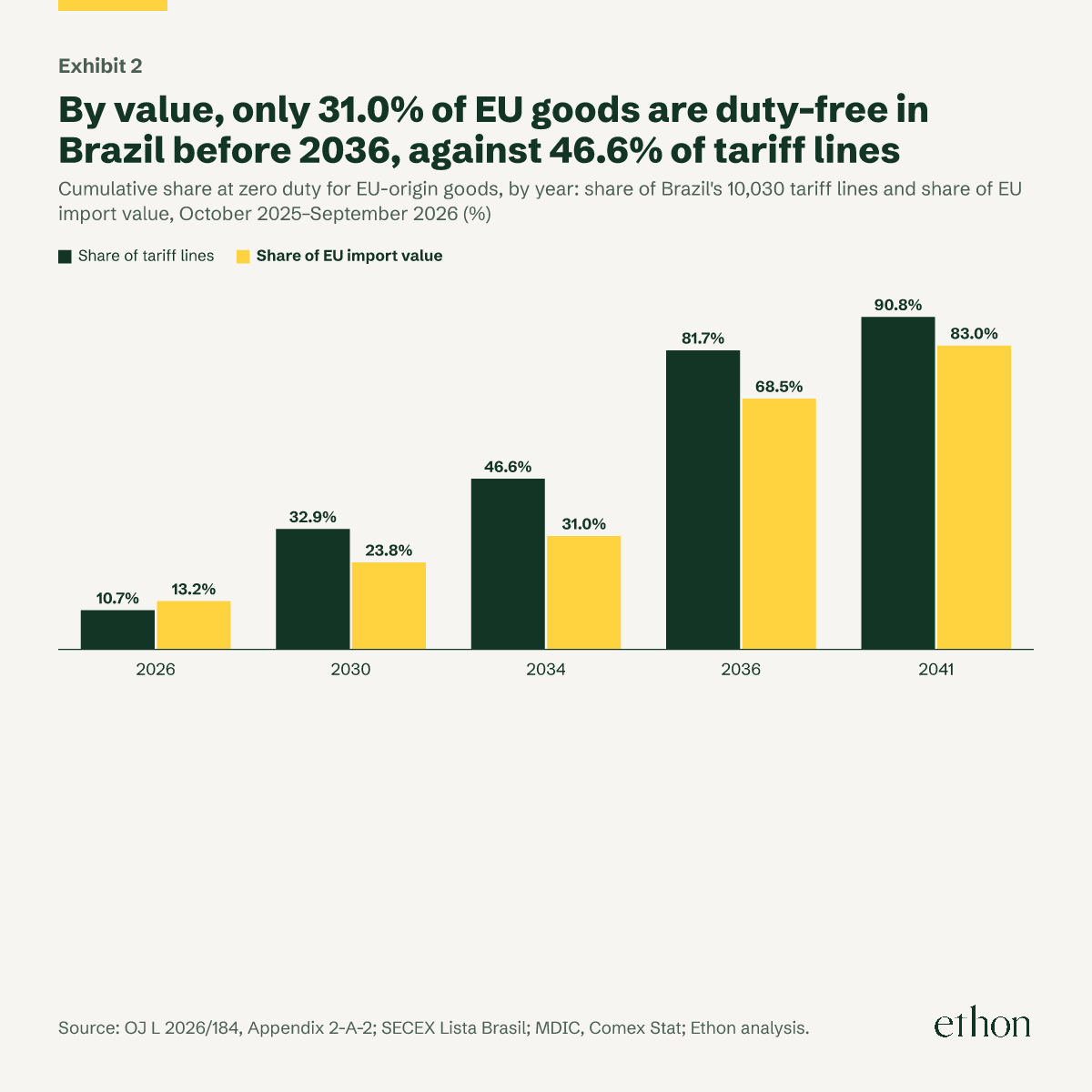
The ten-year category alone holds 37.5% of EU import value, and the fifteen-year categories another 14.5%. The four- and eight-year paths, which make the line count look fast, hold only 17.9% between them. A further 7.1% of value is excluded outright, and 9.8% sits under quotas, special vehicle tables or product codes that Brazil splits into sub-lines with different treatment.
By value, only 31.0% of what the EU sells Brazil is duty-free before 2036.
Machinery carries the largest saving, in the sector where China competes hardest
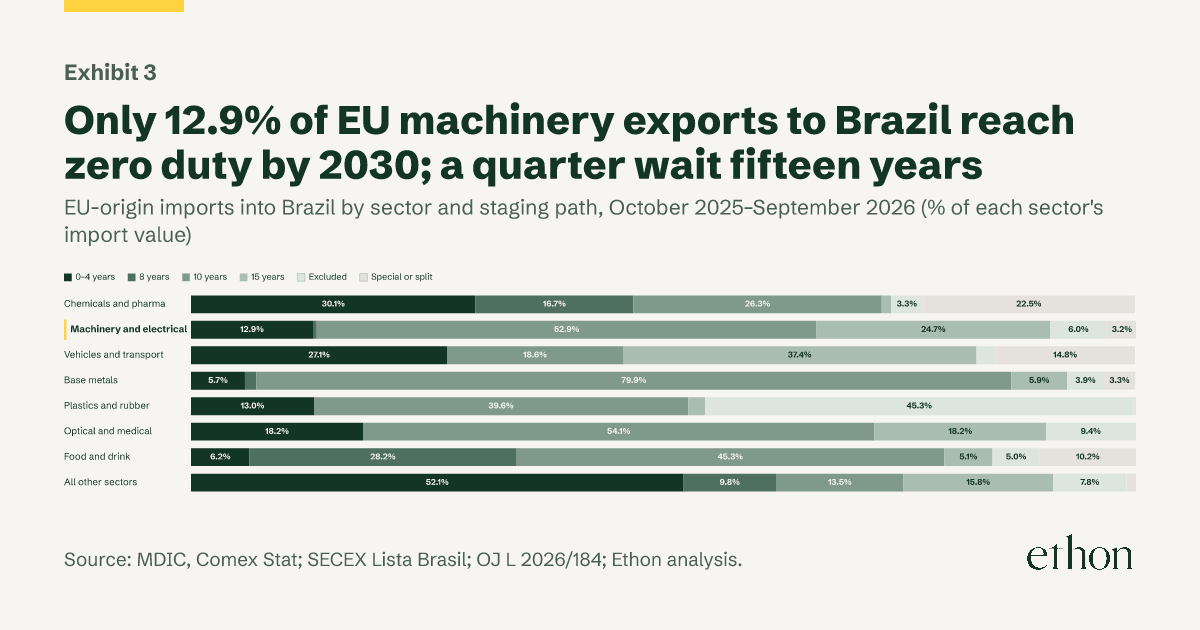
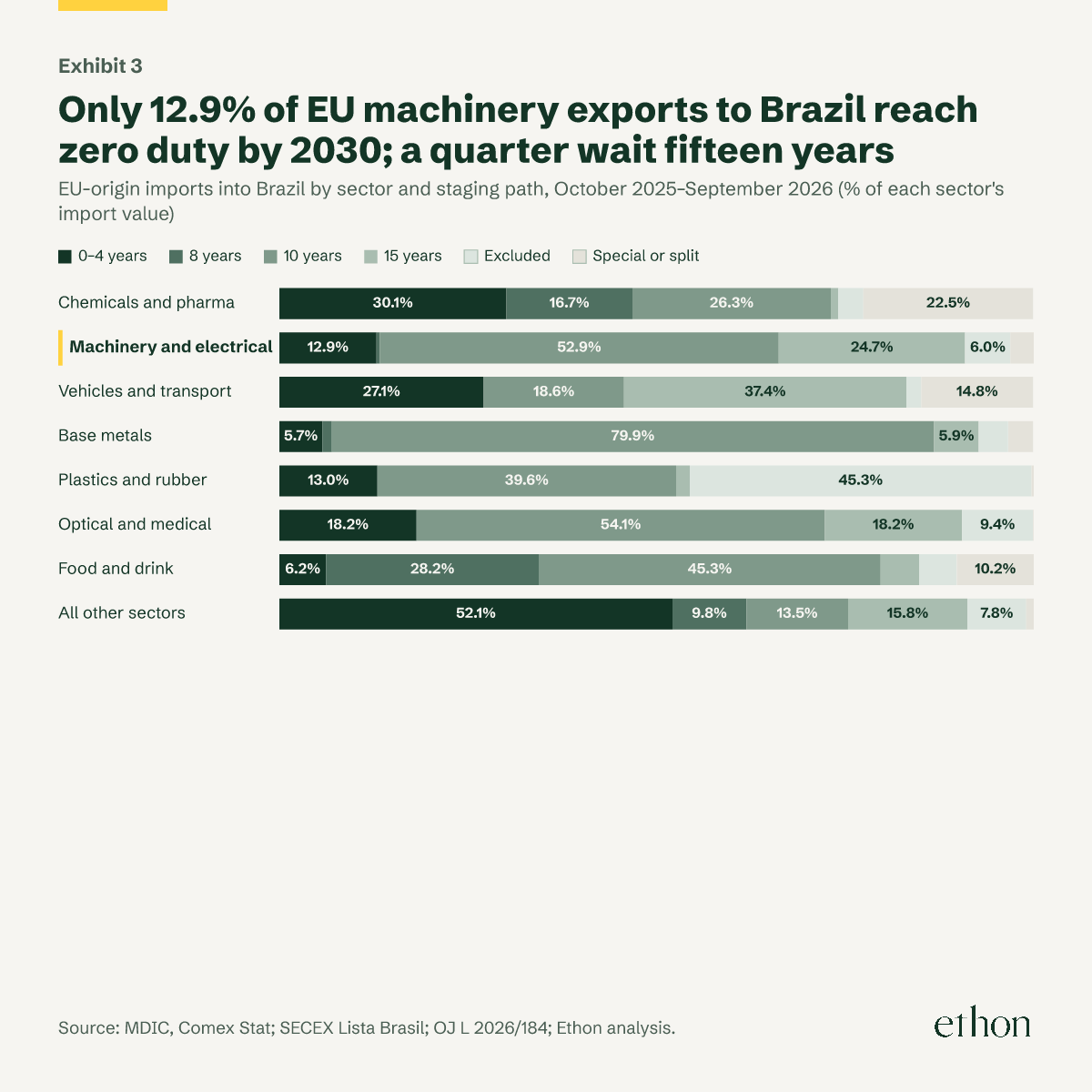
Chemicals and pharmaceuticals (US$15.1bn) and machinery and electrical equipment (US$14.1bn) together make up 57.9% of what the EU sells Brazil. They sit on very different schedules. Chemicals are spread across all paths, with 30.1% of value free by 2030. Machinery is back-loaded: 52.9% of its value is on the ten-year path, a quarter waits fifteen years, and only 12.9% is free by 2030. (See Exhibit 3.)
Exhibit 3
Only 12.9% of EU machinery exports to Brazil reach zero duty by 2030; a quarter wait fifteen years
EU-origin imports into Brazil by sector and staging path, October 2025–September 2026 (% of each sector's import value)
Stacked bars of EU imports into Brazil by sector and staging path. Machinery and electrical (highlighted): 12.9% within four years, 52.9% ten years, 24.7% fifteen years, 6.0% excluded. Plastics and rubber: 45.3% excluded. Base metals: 79.9% ten years. Vehicles: 37.4% fifteen years.
Note: Sectors are HS sections. Fifteen years includes the 15V vehicle category. Special or split: quotas, special vehicle tables and codes whose sub-lines carry different categories. Rows may not sum to 100 because of rounding.
Source: MDIC, Comex Stat; SECEX Lista Brasil; OJ L 2026/184; Ethon analysis.
View data
| 0–4 years | 8 years | 10 years | 15 years | Excluded | Special or split | |
|---|---|---|---|---|---|---|
| Chemicals and pharma | 30.1% | 16.7% | 26.3% | 1.0% | 3.3% | 22.5% |
| Machinery and electrical | 12.9% | 0.4% | 52.9% | 24.7% | 6.0% | 3.2% |
| Vehicles and transport | 27.1% | 0.0% | 18.6% | 37.4% | 2.0% | 14.8% |
| Base metals | 5.7% | 1.2% | 79.9% | 5.9% | 3.9% | 3.3% |
| Plastics and rubber | 13.0% | 0.0% | 39.6% | 1.8% | 45.3% | 0.3% |
| Optical and medical | 18.2% | 0.0% | 54.1% | 18.2% | 9.4% | 0.2% |
| Food and drink | 6.2% | 28.2% | 45.3% | 5.1% | 5.0% | 10.2% |
| All other sectors | 52.1% | 9.8% | 13.5% | 15.8% | 7.8% | 1.1% |
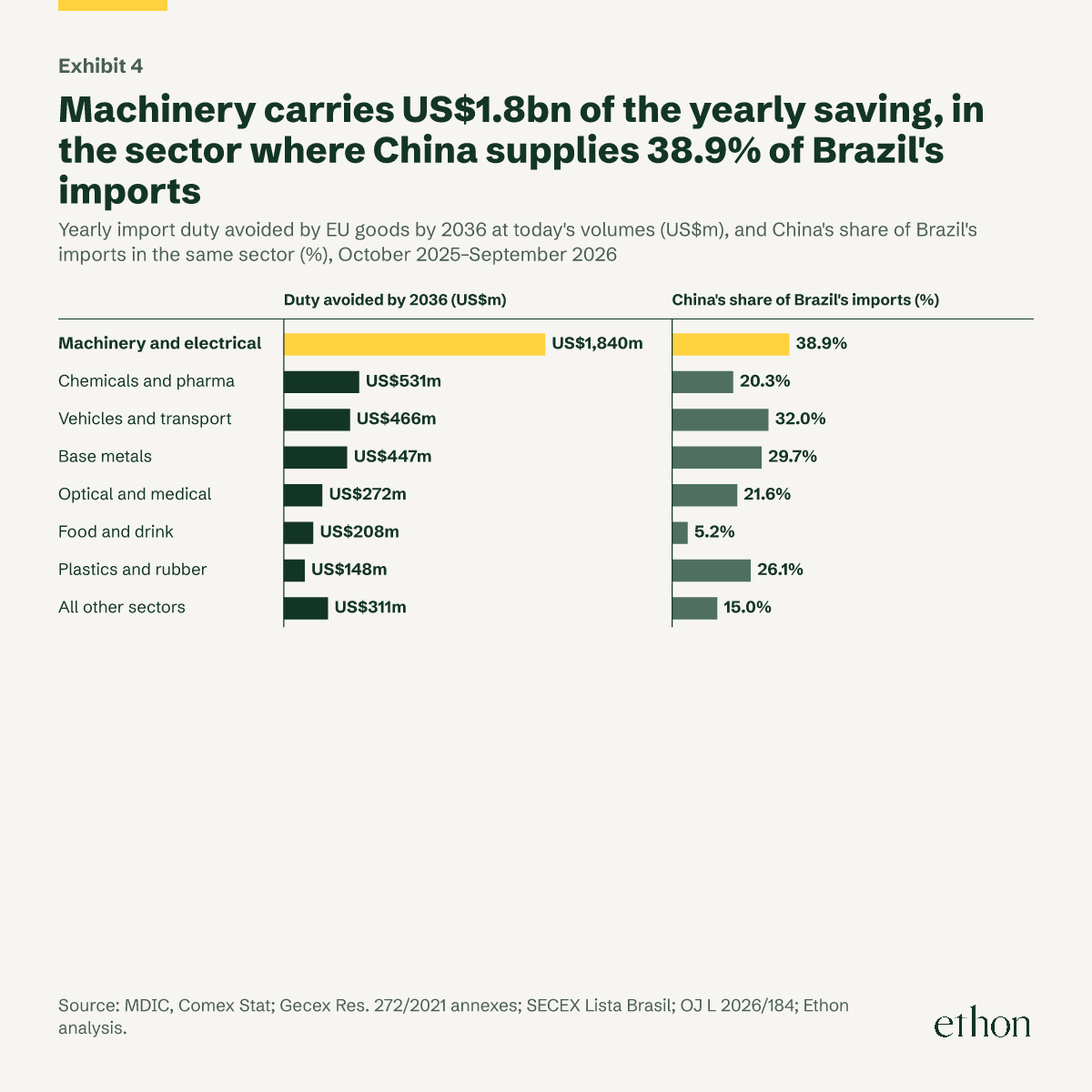
Machinery is also where the duty is highest, at an average applied rate of 15.3% on EU goods, so it carries the largest saving: US$1.8bn a year by 2036, 43.6% of the total. It is the sector where China is strongest. China supplies 38.9% of Brazil’s machinery imports and the EU 18.5%. (See Exhibit 4.)
Exhibit 4
Machinery carries US$1.8bn of the yearly saving, in the sector where China supplies 38.9% of Brazil's imports
Yearly import duty avoided by EU goods by 2036 at today's volumes (US$m), and China's share of Brazil's imports in the same sector (%), October 2025–September 2026
Paired bars by sector. Duty avoided by 2036 in US$m: machinery and electrical 1,840 (highlighted), chemicals and pharma 531, vehicles 466, base metals 447, optical and medical 272, food and drink 208, plastics and rubber 148, all other 311. China's share of Brazil's imports: 38.9%, 20.3%, 32.0%, 29.7%, 21.6%, 5.2%, 26.1% and 15.0%.
Note: Duty avoided under the lower-of reading; the base-rate reading differs by at most US$12m per sector in 2036. Statutory duty at applied rates; ex-tarifário reductions, which matter most for capital goods, are not modelled. Sector totals sum to US$4,223m.
Source: MDIC, Comex Stat; Gecex Res. 272/2021 annexes; SECEX Lista Brasil; OJ L 2026/184; Ethon analysis.
View data
| Duty avoided by 2036 (US$m) | China's share of Brazil's imports (%) | |
|---|---|---|
| Machinery and electrical | US$1,840m | 38.9% |
| Chemicals and pharma | US$531m | 20.3% |
| Vehicles and transport | US$466m | 32.0% |
| Base metals | US$447m | 29.7% |
| Optical and medical | US$272m | 21.6% |
| Food and drink | US$208m | 5.2% |
| Plastics and rubber | US$148m | 26.1% |
| All other sectors | US$311m | 15.0% |
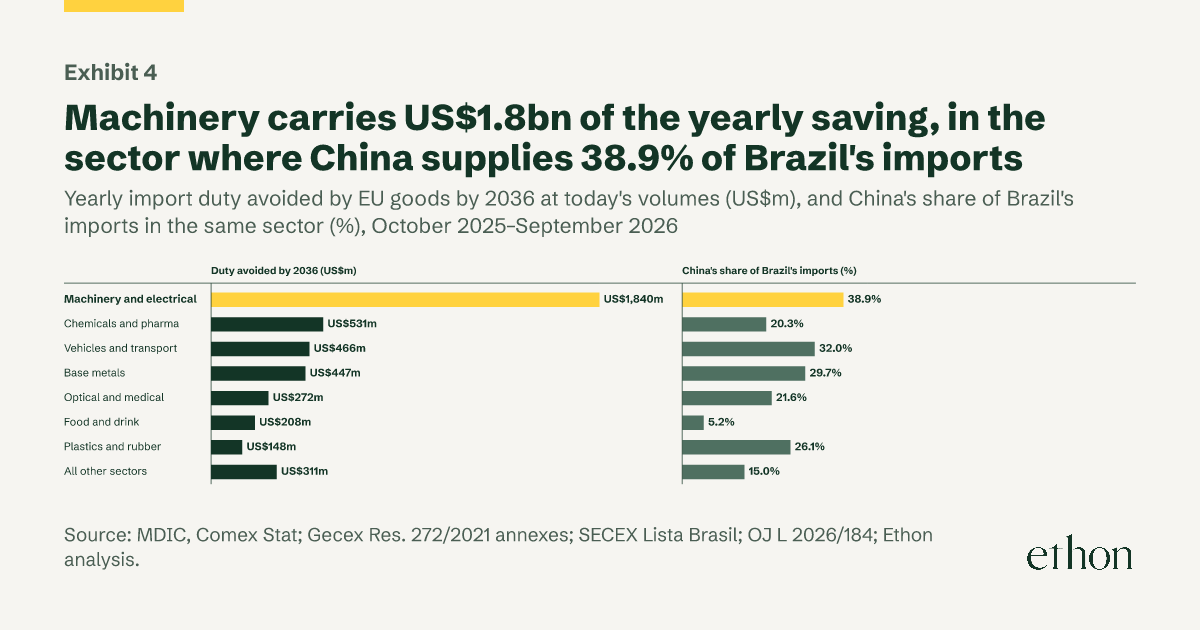
Two cautions apply to the machinery figure. Brazil already grants reduced duty on many specific machines with no local equivalent through ex-tarifário lines, which we do not model, so the real saving in this sector is smaller than the statutory one. And the saving is a margin against Chinese suppliers only if they keep paying the applied rate, which Brazil can change. Plastics and rubber show the opposite risk: 45.3% of EU value there is excluded and gets nothing.
Italy, the corridor Ethon works in, shipped US$7.0bn of goods to Brazil at customs value in the period. At constant volumes its exporters avoid US$0.73bn a year of duty by 2036, 17.3% of the EU total.
The cut is truncated to one decimal, and on some lines the first one is worth nothing
The agreement defines each category as a cumulative cut of the base rate. For category 10 the printed schedule reads 9.1% in year 0 (1 May to 31 December 2026), 18.2% in 2027, and so on to 100% in 2036. Annex 2-A says interim rates are rounded down to at least a tenth of a point. Receita Federal applies that literally. Notícia Siscomex Importação 078/2026 of 29 July 2026 says its Duimp and DI systems truncate the computed rate at the first decimal, replacing earlier two-decimal tables. A 16% line in category 10 pays 14.5% in 2026, 13.0% in 2027, 4.3% in 2033 and zero in 2036.
The harder question is which rate the cut starts from. Article 2.4(7) says that if Brazil’s applied rate is below the base rate, the applied rate replaces it and the cut is applied to that. Notícia 078 says Duimp cuts from the lower of the base rate and the TEC in force. It does not say whether “TEC” includes Brazil’s own reductions below the common external tariff. Food supplements (NCM 2106.90.30) show what is at stake: base rate 16%, category 10, but Brazil already applies 14.4%. (See Exhibit 5.)
Exhibit 5
If Receita cuts from Brazil's 14.4% rate, EU supplements pay 13.0% in 2026 instead of 14.4%
Import duty on food supplements (NCM 2106.90.30) for EU goods under two readings of Art. 2.4(7) and for suppliers paying the applied rate, by year (% of customs value)
Line chart of duty on food supplements from 2026 to 2036. Origins paying the applied rate stay at 14.4%. EU goods under the base-rate reading pay 14.4% in 2026, 13.0% in 2027 and 4.3% in 2033. Under the applied-rate reading (highlighted) they pay 13.0% in 2026, 11.7% in 2027 and 3.9% in 2033. Both reach 0% in 2036.
Note: Category 10, printed cumulative cuts (9.1%, 18.2% … 100%), truncated to 0.1 point. 2026 runs from 1 May; later years from 1 January. The applied rate is held at today's level. Mercosur members such as Argentina, and origins with their own preferences, are not compared.
Source: OJ L 2026/184, Art. 2.4(7), Annex 2-A §6–7 and Appendix 2-A-2 (p. 1357); Receita Federal, Notícia Siscomex Importação 078/2026; SECEX Lista Brasil (rates as at 19 May 2026); Ethon analysis.
View data
| Applied rate (China, US and other origins without a preference) | EU, cut from the 16% base rate | EU, cut from the 14.4% applied rate | |
|---|---|---|---|
| 2026 | 14.4% | 14.4% | 13.0% |
| 2027 | 14.4% | 13.0% | 11.7% |
| 2028 | 14.4% | 11.6% | 10.4% |
| 2029 | 14.4% | 10.1% | 9.1% |
| 2030 | 14.4% | 8.7% | 7.8% |
| 2031 | 14.4% | 7.2% | 6.5% |
| 2032 | 14.4% | 5.8% | 5.2% |
| 2033 | 14.4% | 4.3% | 3.9% |
| 2034 | 14.4% | 2.9% | 2.6% |
| 2035 | 14.4% | 1.4% | 1.3% |
| 2036 | 14.4% | 0.0% | 0.0% |
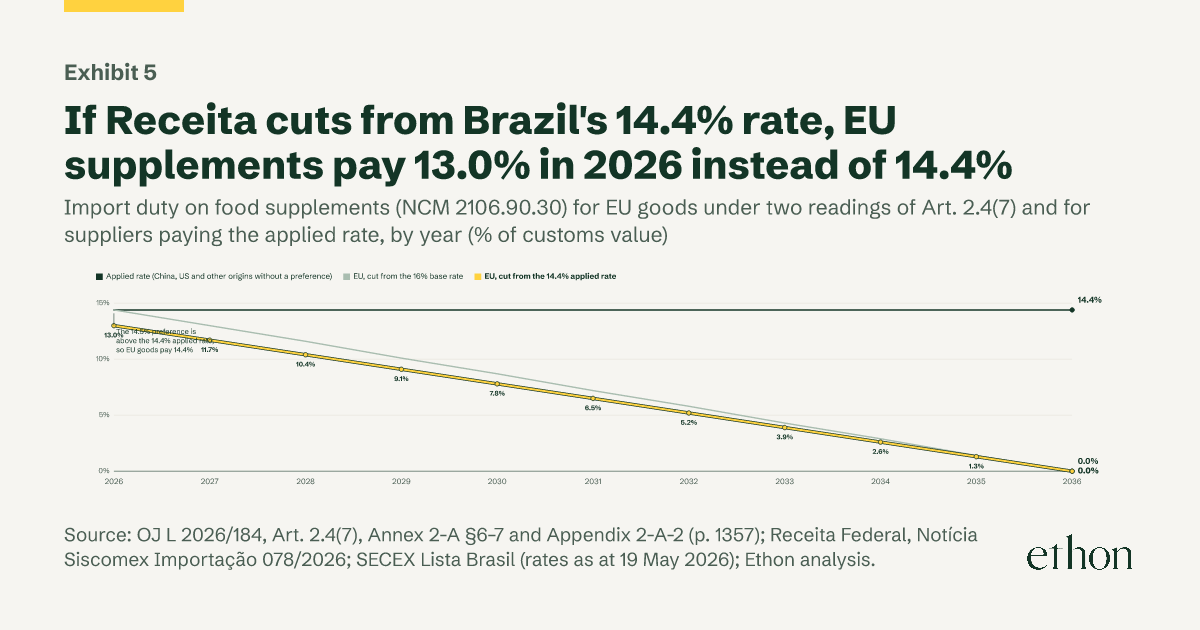
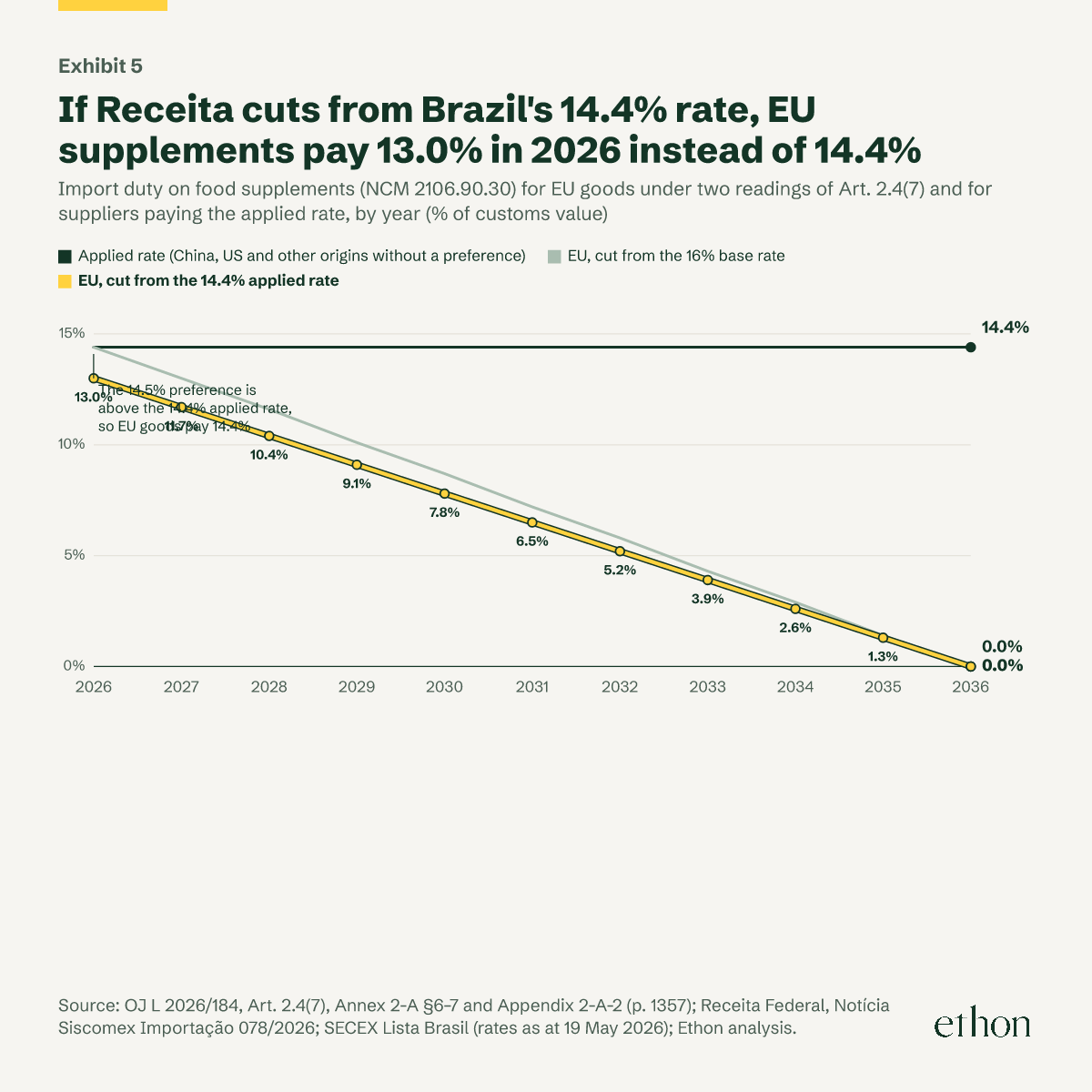
Under the first reading, the 2026 preference of 14.5% sits above the 14.4% Brazil already charges suppliers without a preference, so EU supplements gain nothing until 2027. Under the second, they pay 13.0% from day one. Across all EU trade the two readings differ by US$0.14bn in 2026 and by US$0.02bn in 2036. Ethon’s own tariff tool follows the Duimp rule and flags the question. Until Receita clarifies it, exporters on affected lines should model both.
For a supplement importer, the tax reform lowers everyone’s bill and the agreement widens the EU’s lead
Import duty is only the first layer. A regular-regime importer in São Paulo also pays PIS and COFINS and then ICMS, which is calculated on a base that includes the duty. From 2027 Brazil’s tax reform starts replacing PIS, COFINS and later ICMS with CBS and IBS. The reform changes the level for every origin. The agreement changes the gap. (See Exhibit 6.)
Exhibit 6
By 2033 an EU food supplement pays 33.4 or less per 100 of value at Brazil's border, against 46.3 for a supplier without a preference
Total import taxes on food supplements (NCM 2106.90.30) entering São Paulo, regular-regime importer, per 100 of customs value (CIF)
Grouped columns of total import taxes per 100 of customs value on food supplements in São Paulo. No preference: 53.84 today, 51.79 in 2027, 46.33 in 2033. EU, base-rate reading: 53.84, 49.93, 33.41. EU, applied-rate reading: 52.13, 48.21, 32.90. 2033 is highlighted.
Note: Import duty, PIS and COFINS, ICMS at 18% (São Paulo), and from 2027 CBS and IBS; IPI is 0% on this code. 2027 CBS (8.7%) and 2033 CBS plus IBS (27.91%) are estimates pending the Senate resolution and CGIBS reference rates. Fees (AFRMM, Siscomex, port, broker) excluded. Of the 2033 gap of 12.9 points (base reading), 10.1 is duty the competitor cannot recover as a credit.
Source: LC 214/2025; Lei 10.865/2004; LC 87/1996; Receita Federal TIPI; Decreto 6.759/2009 arts. 75 and 77; CGIBS Res. 14/2026; OJ L 2026/184; Ethon analysis.
View data
| No preference (e.g. China, US) | EU, cut from the 16% base rate | EU, cut from the 14.4% applied rate | |
|---|---|---|---|
| Today | 53.8 | 53.8 | 52.1 |
| 2027 | 51.8 | 49.9 | 48.2 |
| 2033 | 46.3 | 33.4 | 32.9 |
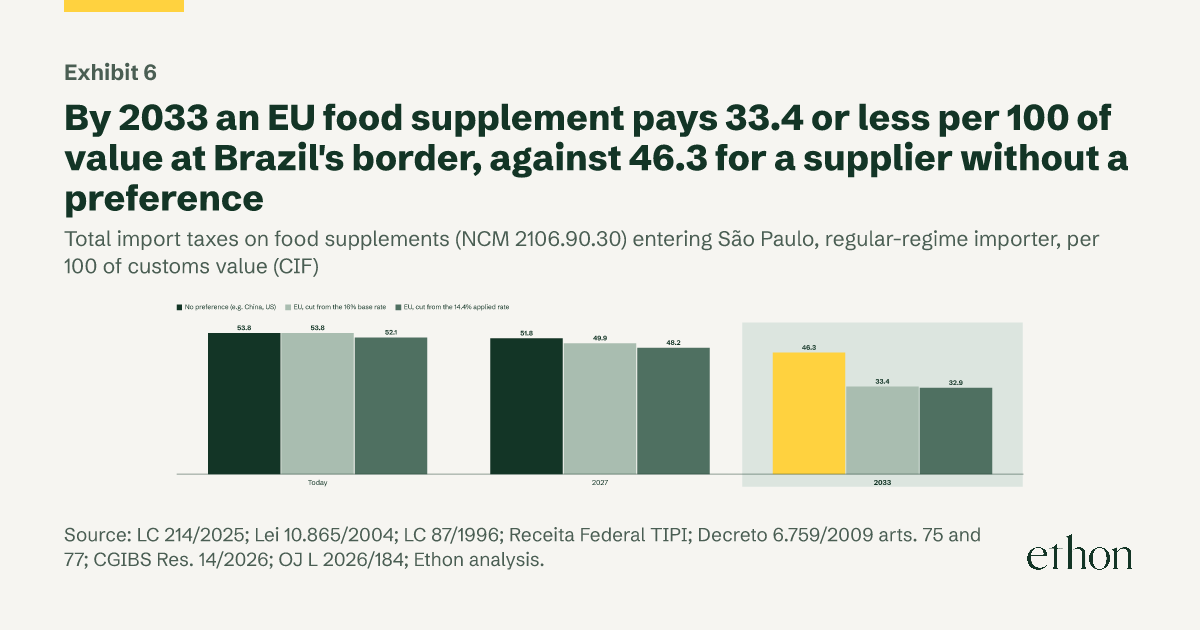
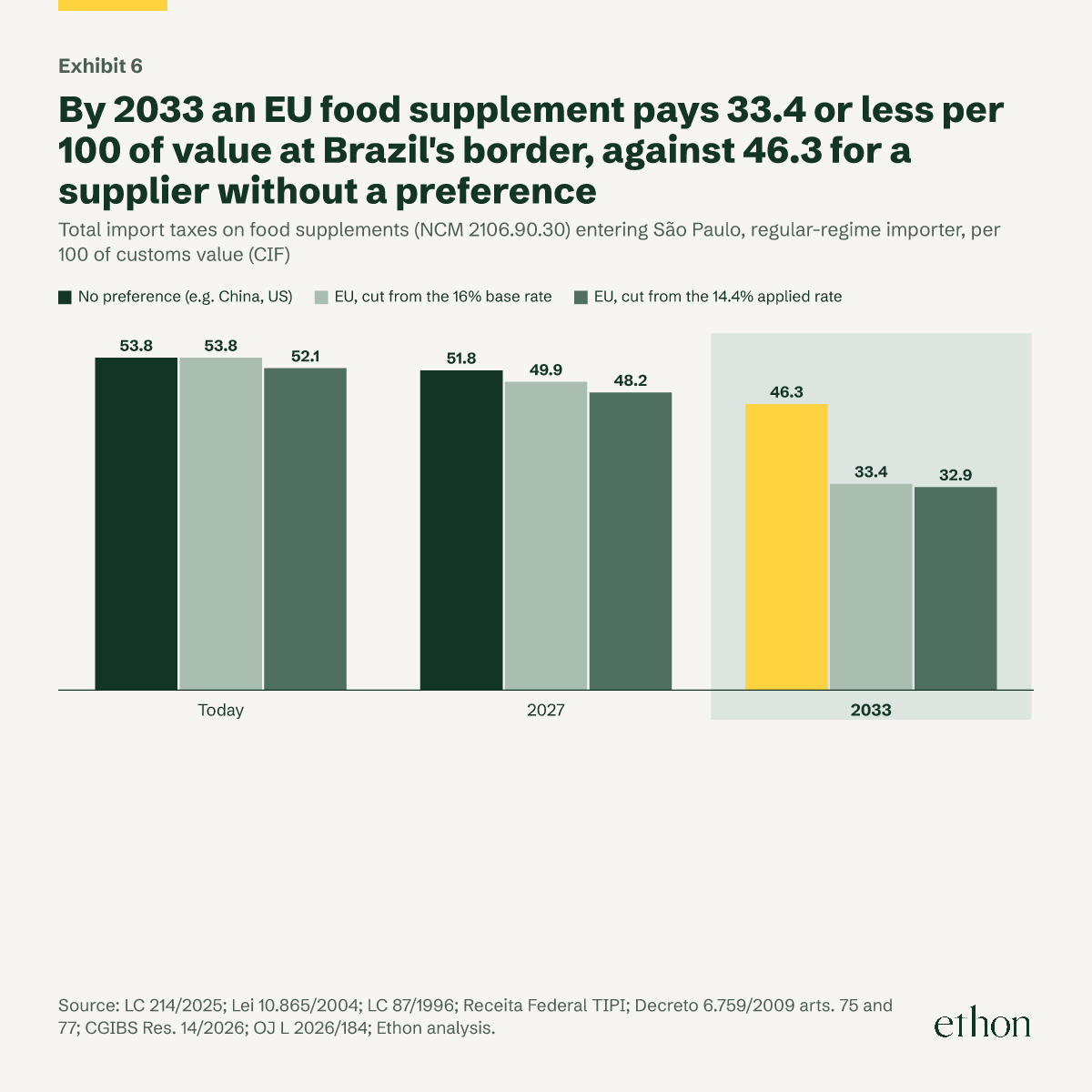
Today the stack adds up to 53.8 per 100 of customs value for everyone, unless Receita takes the second reading. By 2033 the reform alone brings a supplier without a preference down to 46.3. The agreement takes an EU supplier to 33.4 or less. For a business buyer most of these taxes come back as credits; the import duty does not. Of the 12.9-point gap in 2033, 10.1 points are duty the competitor can never recover.
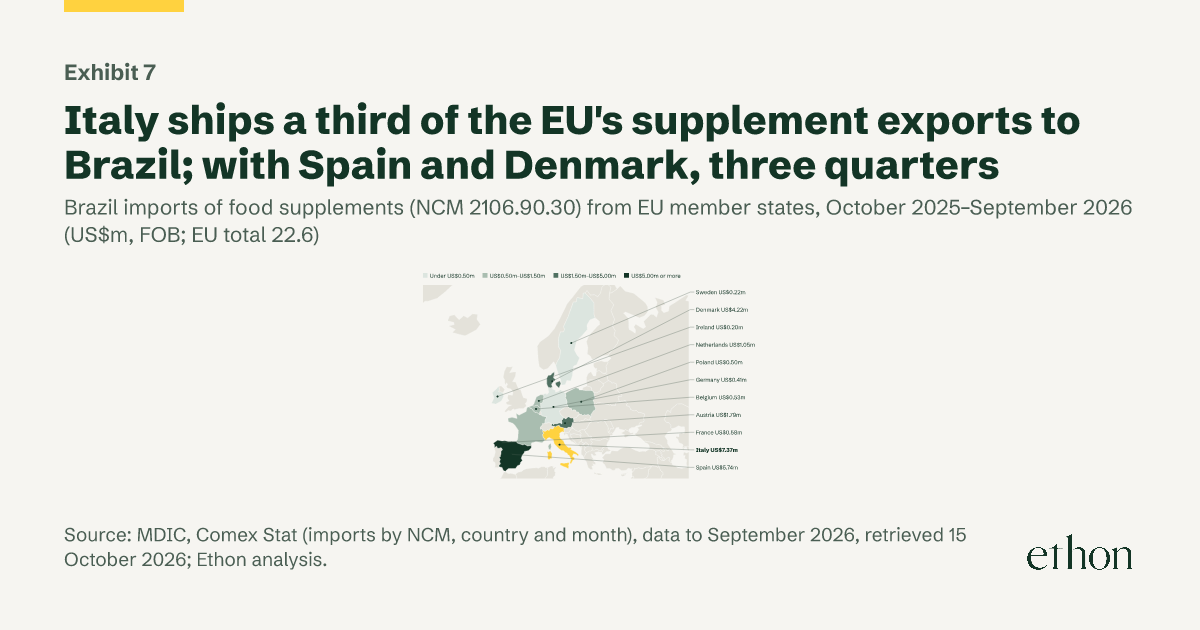
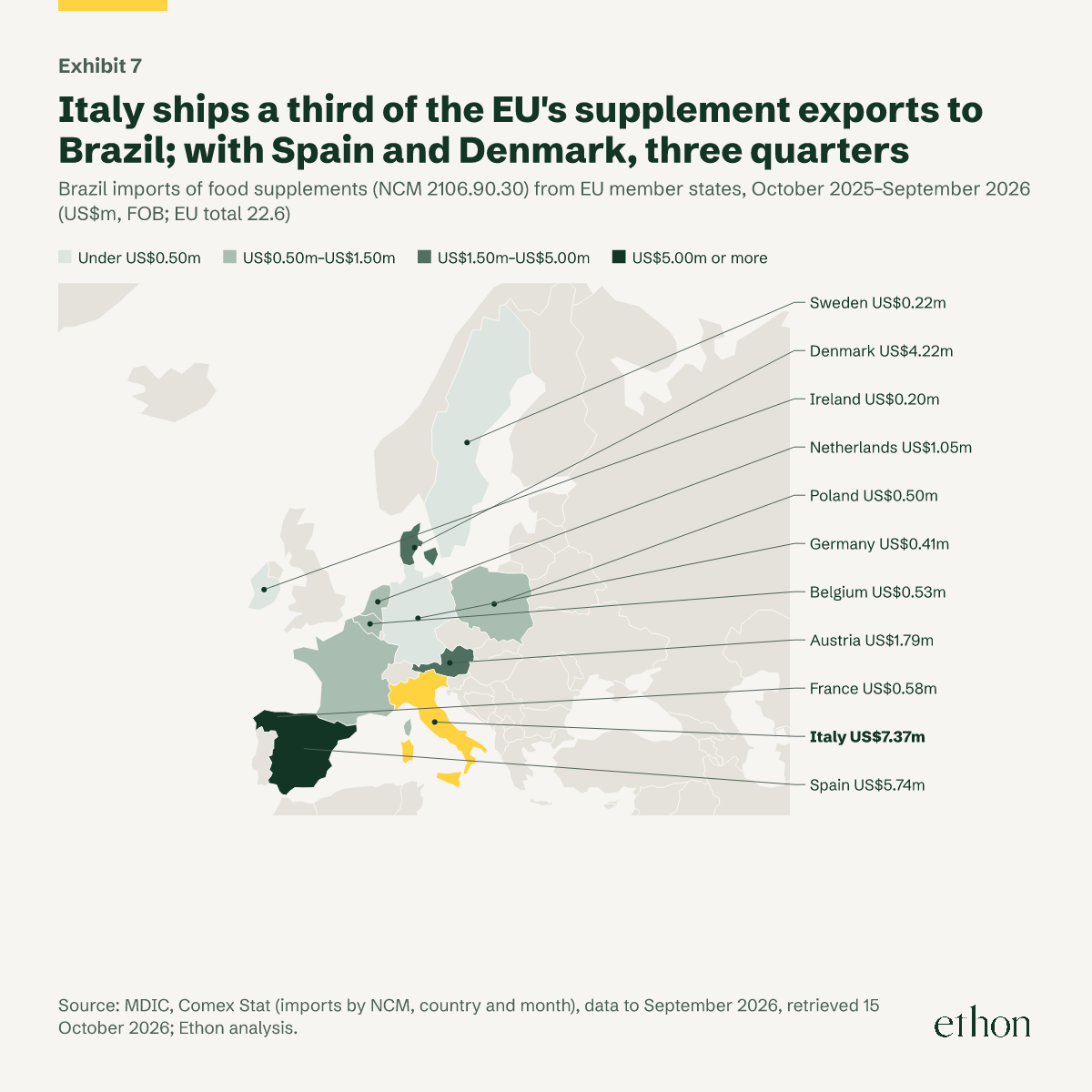
The EU already leads this market. Brazil imported US$60.1m of supplements in the twelve months to September 2026, 37.6% of it from the EU, ahead of China at 21.9% and the United States at 15.8%. Within the EU, Italy alone shipped US$7.4m, a third of the total, and Italy, Spain and Denmark together 76.6%. (See Exhibit 7.)
Exhibit 7
Italy ships a third of the EU's supplement exports to Brazil; with Spain and Denmark, three quarters
Brazil imports of food supplements (NCM 2106.90.30) from EU member states, October 2025–September 2026 (US$m, FOB; EU total 22.6)
Map of Europe shaded by supplement exports to Brazil over the 12 months to September 2026. Italy (highlighted) US$7.37m, Spain 5.74, Denmark 4.22, Austria 1.79, Netherlands 1.05, France 0.58, Belgium 0.53, Poland 0.50, Germany 0.41, Sweden 0.22, Ireland 0.20.
Note: Sixteen member states shipped nothing in the period. Shares of the EU total: Italy 32.6%, Spain 25.4%, Denmark 18.6%. Map boundaries: Natural Earth.
Source: MDIC, Comex Stat (imports by NCM, country and month), data to September 2026, retrieved 15 October 2026; Ethon analysis.
View data
| US$m | |
|---|---|
| Italy | US$7.37m |
| Spain | US$5.74m |
| Denmark | US$4.22m |
| Austria | US$1.79m |
| Netherlands | US$1.05m |
| France | US$0.58m |
| Belgium | US$0.53m |
| Poland | US$0.50m |
| Germany | US$0.41m |
| Sweden | US$0.22m |
| Ireland | US$0.20m |
What it means for EU exporters
Plan for a glide, not a cliff. By value, 86.8% of EU goods still paid duty after 1 May 2026, and most of the saving arrives between 2030 and 2036. Price and margin plans that assume zero duty now will be wrong for most products.
Find your line before you read the headlines. The eight-digit NCM code decides the path, not the sector. Within machinery, 12.9% of value is free by 2030 and a quarter waits until 2041. In plastics and rubber, 45.3% of value is excluded.
Model both readings where Brazil already charges less than the base rate. For supplements the difference is 1.4 points in 2026 and fades by 2036. On thin margins it decides whether the first year is worth pursuing.
Count the full stack, not just the duty. Because Brazil’s other import taxes are calculated on a base that includes the duty, a lower duty lowers them too. For supplements the 2033 gap against a competitor without a preference is 12.9 points of total tax, of which 10.1 is unrecoverable.
Secure origin and watch the legal risk. The preference requires proof of EU origin under the agreement’s rules of origin and must be claimed by the importer. The agreement applies provisionally while the Court of Justice of the EU considers a request from the European Parliament, made on 21 January 2026, for an opinion on its compatibility with the EU treaties.
Questions this analysis answers
How much will EU exporters save in Brazilian import duty under EU–Mercosur?
About US$4.2bn a year by 2036, if volumes, prices and Brazil’s applied rates stay at their level of October 2025 to September 2026. That is three quarters of the US$5.7bn of statutory duty EU goods carry today. The saving starts at US$0.8bn–0.9bn a year in 2026.
When does Brazil’s import duty on EU goods reach zero?
It depends on the product’s staging category. By value, 13.2% of EU goods were duty-free from 1 May 2026, 31.0% are by 2034 and 68.5% by 2036; 7.1% is excluded and never reaches zero.
Do EU food supplements pay less duty in Brazil in 2026?
Possibly not. The agreement’s 2026 preference for NCM 2106.90.30 is 14.5%, above the 14.4% Brazil already applies. They pay 13.0% only if Receita applies the cut to the 14.4% rate, a question that is still open.
Methodology
Schedule. We parsed Appendix 2-A-2 from the XHTML edition of the agreement in the Official Journal (OJ L 2026/184, 27 February 2026) and cross-checked it against the PDF edition and the Commission’s 2025 draft: 10,030 lines keyed on NCM 2012. To match current product codes we used SECEX’s Lista Brasil, which maps each current NCM to its category; on the 9,091 lines whose code is unchanged since 2012 it agrees with our parse on every base rate and category.
Trade. EU imports are the sum over the EU-27 member states (by ISO code) of Comex Stat bulk import records for October 2025 to September 2026: US$50.6bn FOB and US$52.1bn CIF, against US$290.9bn for all origins. The total for all origins matches the Comex Stat API to the dollar, and the EU total matches the API’s EU bloc to within 0.03%.
Rates and saving. Brazil’s applied rate per code comes from the Gecex Res. 272/2021 annexes (updated to Res. 926/2026): the TEC, replaced by the Anexo II rate where one exists and by any whole-code exception in force on 15 October 2026. The EU rate for each year is the agreement’s cut, truncated to 0.1 point, applied either to the base rate or to the lower of base and applied rate, and never above the applied rate. The yearly saving is EU imports at CIF multiplied by the gap. Codes under quotas, special tables or split sub-lines count as zero saving. Ex-tarifário reductions, drawback and special regimes are not modelled, so the statutory bill and the saving overstate what is collected today.
Landed cost. Total import taxes for NCM 2106.90.30 come from Ethon’s import-tax calculator, built on LC 214/2025, Lei 10.865/2004, LC 87/1996 and the TIPI, for a regular-regime importer in São Paulo. The 2027 and 2033 CBS and IBS rates are estimates.
Open question. Whether “TEC in force” in Notícia 078 includes Brazil’s own reductions below the common external tariff is not settled. We show both readings wherever it changes a number.
Sources
- Official Journal of the European Union. Interim Trade Agreement between the European Union and Mercosur, OJ L 2026/184 (27.2.2026): Chapter 2 Art. 2.4, Annex 2-A and Appendix 2-A-2 (Mercosur schedule)
- Receita Federal do Brasil. Notícia Siscomex Importação nº 078/2026 (29 July 2026): truncation and base-rate rule for the Mercosur–EU agreement
- SECEX, Ministério do Desenvolvimento, Indústria, Comércio e Serviços. Acordo Mercosul–União Europeia: Lista Brasil, preferências tarifárias na importação por NCM (indicative)
- MDIC, Comex Stat. Brazil imports of NCM 21069030 (complementos alimentares) by country and month, FOB and CIF
- Presidência da República. Decreto nº 6.759/2009 (Regulamento Aduaneiro), arts. 75 and 77: duty base and customs value
- European Parliament. EU-Mercosur: MEPs demand a legal opinion on its conformity with the EU treaties (press release)
- Natural Earth. Admin 0 countries, 1:110m
- MDIC, Comex Stat. Brazil imports by NCM, country and month, bulk files IMP_2025 and IMP_2026 (FOB, freight, insurance)
- Gecex/Camex, MDIC. Resolução Gecex nº 272/2021, Anexos I a X (TEC, applied rates and exception lists), updated to Res. Gecex nº 926 of 24 June 2026
- Presidência da República. Lei Complementar nº 214/2025 (CBS, IBS and Imposto Seletivo), consolidated
- Presidência da República. Lei nº 10.865/2004 (PIS/COFINS-Importação)
- Presidência da República. Lei Complementar nº 87/1996 (ICMS on imports, art. 13)
- Receita Federal do Brasil. TIPI, IPI rates by NCM (Decreto 11.158/2022, as updated)
- Comitê Gestor do IBS. Resolução CGIBS nº 14/2026, reference-rate estimates for CBS and IBS