
Insights · 3-minute version
EU–Mercosur in three minutes: US$4.2bn a year for EU exporters, mostly after 2034
The short version of our analysis of Brazil's tariff schedule for EU goods, weighted by what the EU actually sells.
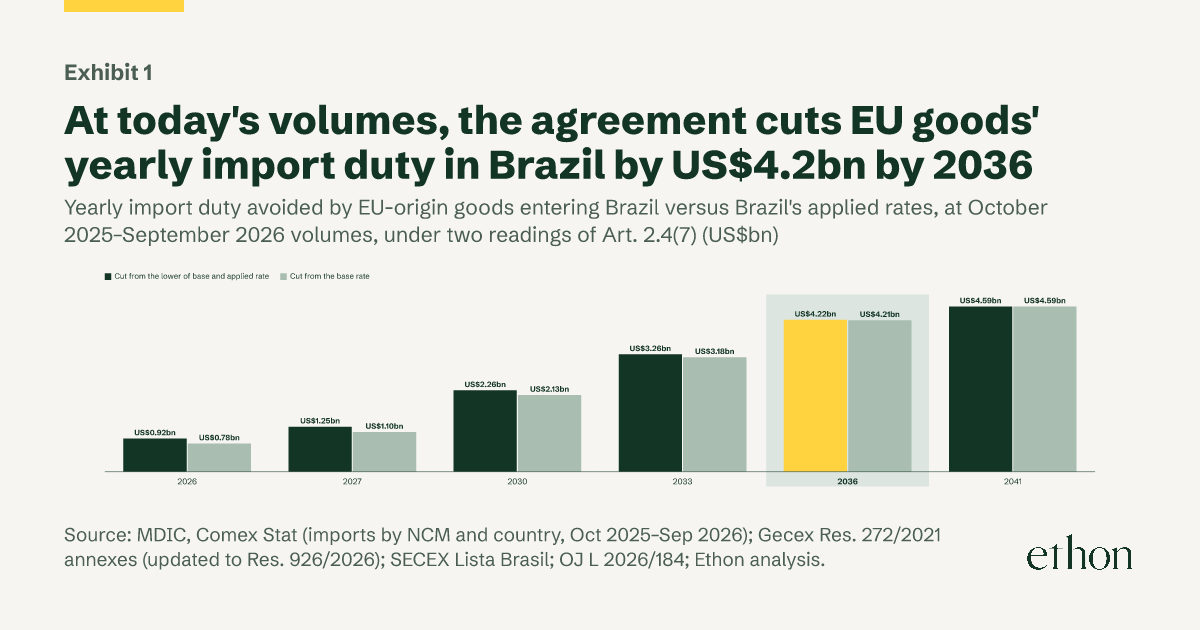
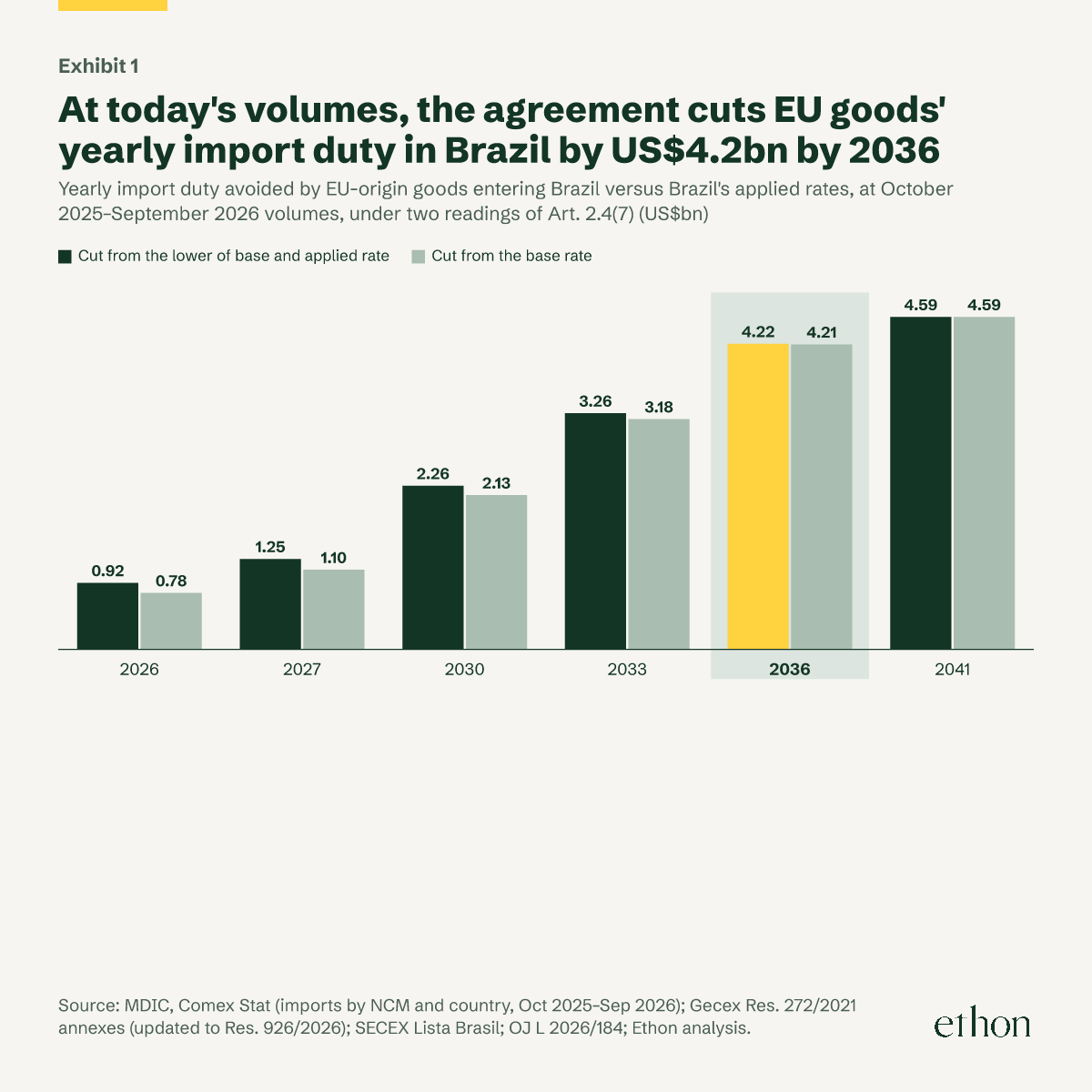
Brazil imported US$50.6bn of goods from the EU in the year to September 2026. At today’s applied rates those goods carry about US$5.7bn of import duty a year. Since 1 May 2026 the EU–Mercosur agreement has been cutting that bill. Held at today’s volumes, the yearly saving grows from about US$0.8bn–0.9bn in 2026 to US$4.2bn in 2036, three quarters of the current bill. (See Exhibit 1.)
Exhibit 1
At today's volumes, the agreement cuts EU goods' yearly import duty in Brazil by US$4.2bn by 2036
Yearly import duty avoided by EU-origin goods entering Brazil versus Brazil's applied rates, at October 2025–September 2026 volumes, under two readings of Art. 2.4(7) (US$bn)
Column chart of yearly import duty avoided by EU goods entering Brazil at today's volumes. Reading one: US$0.92bn in 2026, 1.25 in 2027, 2.26 in 2030, 3.26 in 2033, 4.22 in 2036 (highlighted) and 4.59 in 2041. Reading two: 0.78, 1.10, 2.13, 3.18, 4.21 and 4.59.
Note: Statutory duty at applied rates on EU imports of US$52.1bn (CIF); today's bill is US$5.66bn. Constant volumes, prices and applied rates. 2026 shown at the year-0 rate for a full year. No saving counted for the 9.8% of value under quotas, special tables or split sub-lines. Ex-tarifário reductions, drawback and special regimes are not modelled, so actual duty paid today, and the saving, are lower.
Source: MDIC, Comex Stat (imports by NCM and country, Oct 2025–Sep 2026); Gecex Res. 272/2021 annexes (updated to Res. 926/2026); SECEX Lista Brasil; OJ L 2026/184; Ethon analysis.
View data
| Cut from the lower of base and applied rate | Cut from the base rate | |
|---|---|---|
| 2026 | US$0.92bn | US$0.78bn |
| 2027 | US$1.25bn | US$1.10bn |
| 2030 | US$2.26bn | US$2.13bn |
| 2033 | US$3.26bn | US$3.18bn |
| 2036 | US$4.22bn | US$4.21bn |
| 2041 | US$4.59bn | US$4.59bn |
Weighted by trade, the schedule is slower than it looks
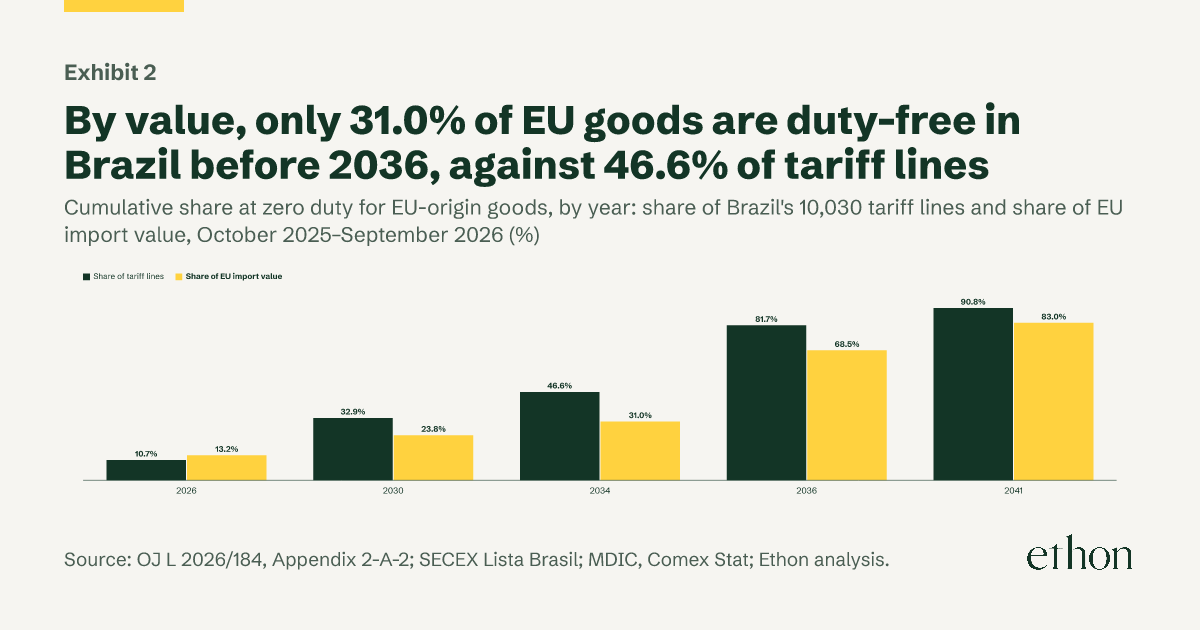
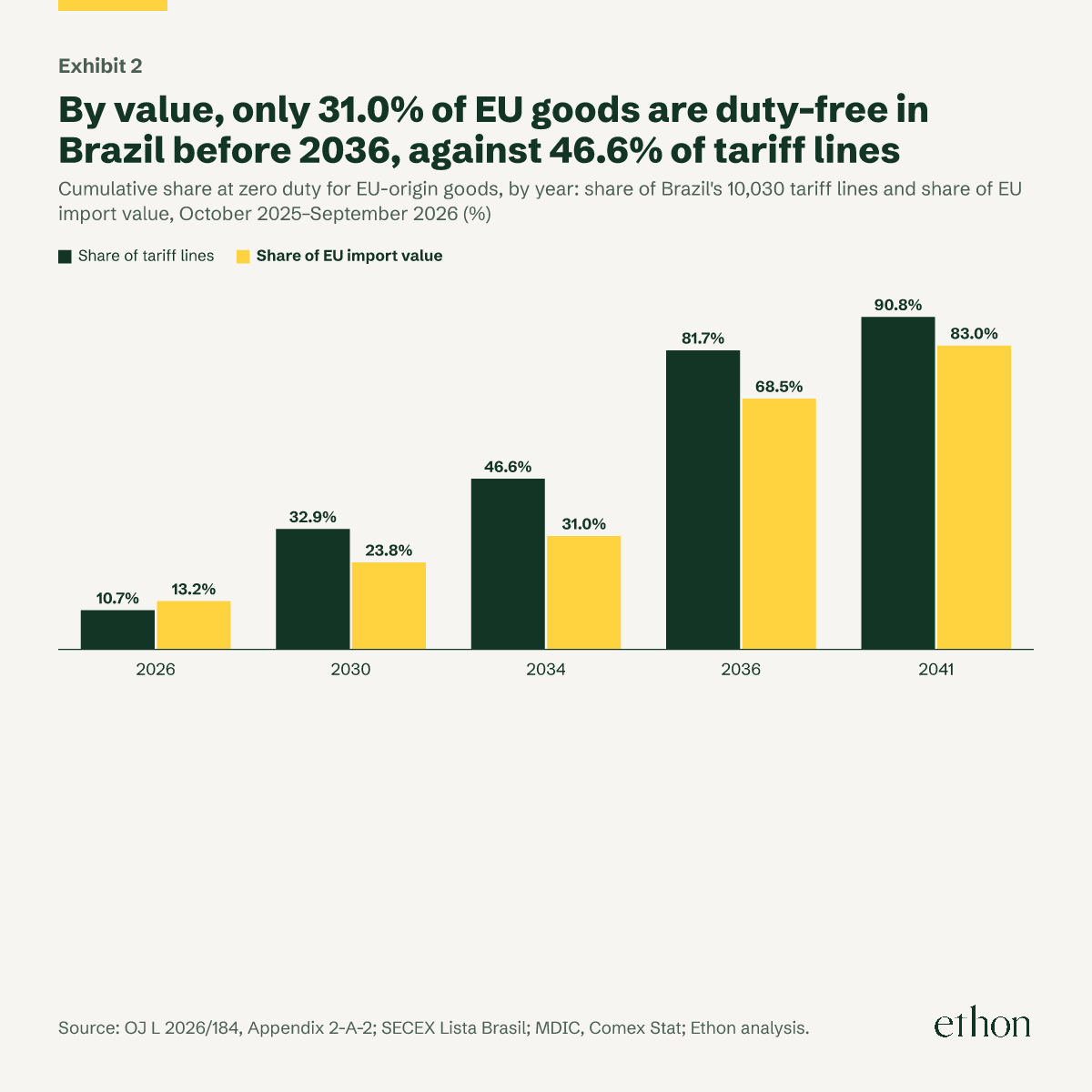
Counted by tariff lines, 46.6% of Brazil’s schedule is duty-free for EU goods by 2034. Weighted by what the EU actually sells, only 31.0% is. The ten-year category, which reaches zero in 2036, holds 37.5% of EU import value on its own, and 7.1% of value is excluded for good. For most EU exporters the agreement is a glide that lands in 2036, not a switch that flipped in 2026. (See Exhibit 2.)
Exhibit 2
By value, only 31.0% of EU goods are duty-free in Brazil before 2036, against 46.6% of tariff lines
Cumulative share at zero duty for EU-origin goods, by year: share of Brazil's 10,030 tariff lines and share of EU import value, October 2025–September 2026 (%)
Column chart comparing the share of Brazil's tariff lines and the share of EU import value at zero duty. Lines: 10.7% in 2026, 32.9% in 2030, 46.6% in 2034, 81.7% in 2036, 90.8% in 2041. Value (highlighted): 13.2%, 23.8%, 31.0%, 68.5% and 83.0%.
Note: Position on 1 January of each year, except 2026 (1 May). Lines: agreement schedule (NCM 2012). Value: EU imports of US$50.6bn FOB by current NCM, mapped to categories with SECEX's Lista Brasil. Lines and value under quotas, special tables or split sub-lines are not counted as reaching zero.
Source: OJ L 2026/184, Appendix 2-A-2; SECEX Lista Brasil; MDIC, Comex Stat; Ethon analysis.
View data
| Share of tariff lines | Share of EU import value | |
|---|---|---|
| 2026 | 10.7% | 13.2% |
| 2030 | 32.9% | 23.8% |
| 2034 | 46.6% | 31.0% |
| 2036 | 81.7% | 68.5% |
| 2041 | 90.8% | 83.0% |
Machinery gains most, where China competes hardest
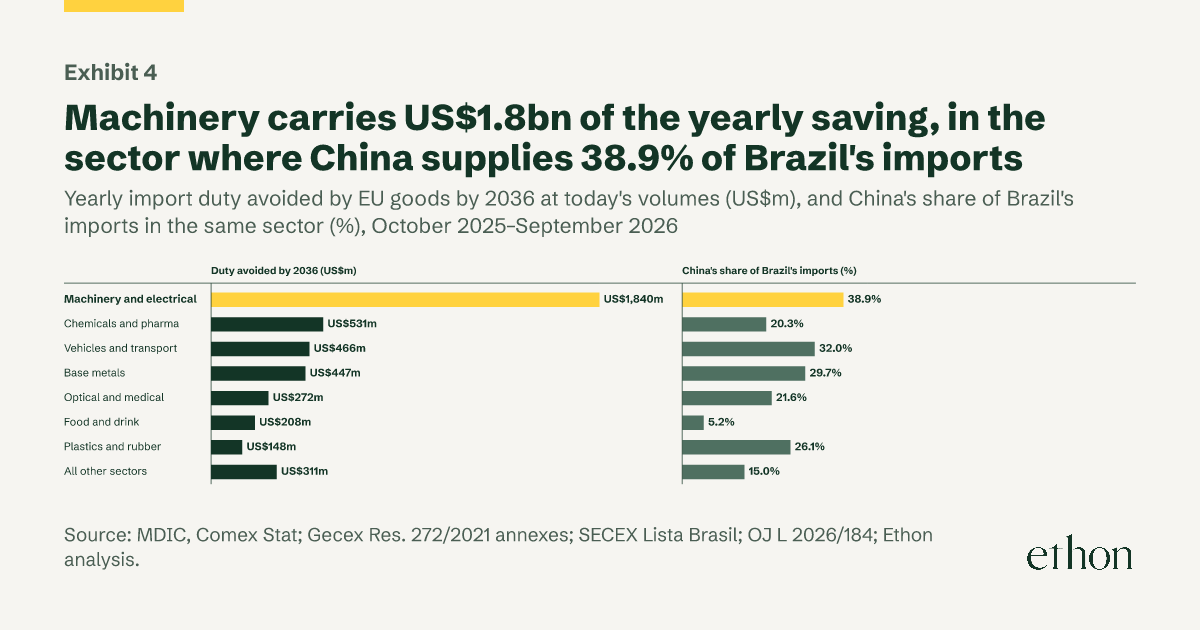
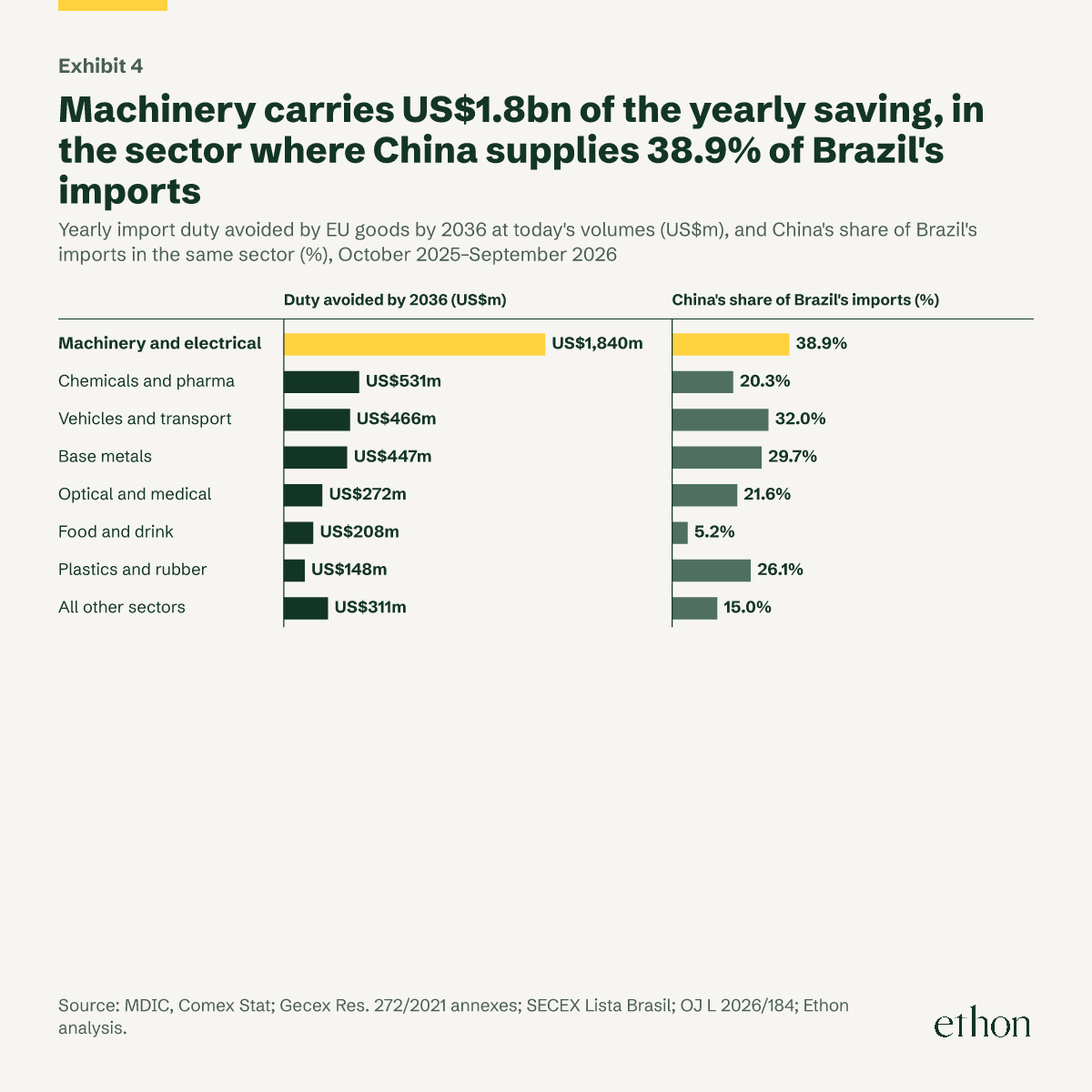
Machinery and electrical equipment carry US$1.8bn of the yearly saving by 2036, 43.6% of the total, because duty there averages 15.3%. It is also the sector where China supplies 38.9% of Brazil’s imports, against the EU’s 18.5%. The saving is statutory: Brazil already cuts duty on many specific machines through ex-tarifário lines, so the real gain there is smaller. In plastics and rubber, by contrast, 45.3% of EU value is excluded and gains nothing. (See Exhibit 4.)
Exhibit 4
Machinery carries US$1.8bn of the yearly saving, in the sector where China supplies 38.9% of Brazil's imports
Yearly import duty avoided by EU goods by 2036 at today's volumes (US$m), and China's share of Brazil's imports in the same sector (%), October 2025–September 2026
Paired bars by sector. Duty avoided by 2036 in US$m: machinery and electrical 1,840 (highlighted), chemicals and pharma 531, vehicles 466, base metals 447, optical and medical 272, food and drink 208, plastics and rubber 148, all other 311. China's share of Brazil's imports: 38.9%, 20.3%, 32.0%, 29.7%, 21.6%, 5.2%, 26.1% and 15.0%.
Note: Duty avoided under the lower-of reading; the base-rate reading differs by at most US$12m per sector in 2036. Statutory duty at applied rates; ex-tarifário reductions, which matter most for capital goods, are not modelled. Sector totals sum to US$4,223m.
Source: MDIC, Comex Stat; Gecex Res. 272/2021 annexes; SECEX Lista Brasil; OJ L 2026/184; Ethon analysis.
View data
| Duty avoided by 2036 (US$m) | China's share of Brazil's imports (%) | |
|---|---|---|
| Machinery and electrical | US$1,840m | 38.9% |
| Chemicals and pharma | US$531m | 20.3% |
| Vehicles and transport | US$466m | 32.0% |
| Base metals | US$447m | 29.7% |
| Optical and medical | US$272m | 21.6% |
| Food and drink | US$208m | 5.2% |
| Plastics and rubber | US$148m | 26.1% |
| All other sectors | US$311m | 15.0% |
One open question still moves the numbers
Receita Federal cuts from the lower of the agreement’s base rate and the tariff in force, but has not said whether that includes Brazil’s own reductions. For food supplements, where Brazil applies 14.4% against a 16% base, it decides whether EU goods pay 14.4% or 13.0% in 2026. Across all EU trade the two readings differ by US$0.14bn in 2026 and by US$0.02bn in 2036. Exporters on affected lines should model both.
The full analysis covers the sector-by-sector schedule, the rounding rule, and a supplement traced through Brazil’s whole tax stack to 2033.